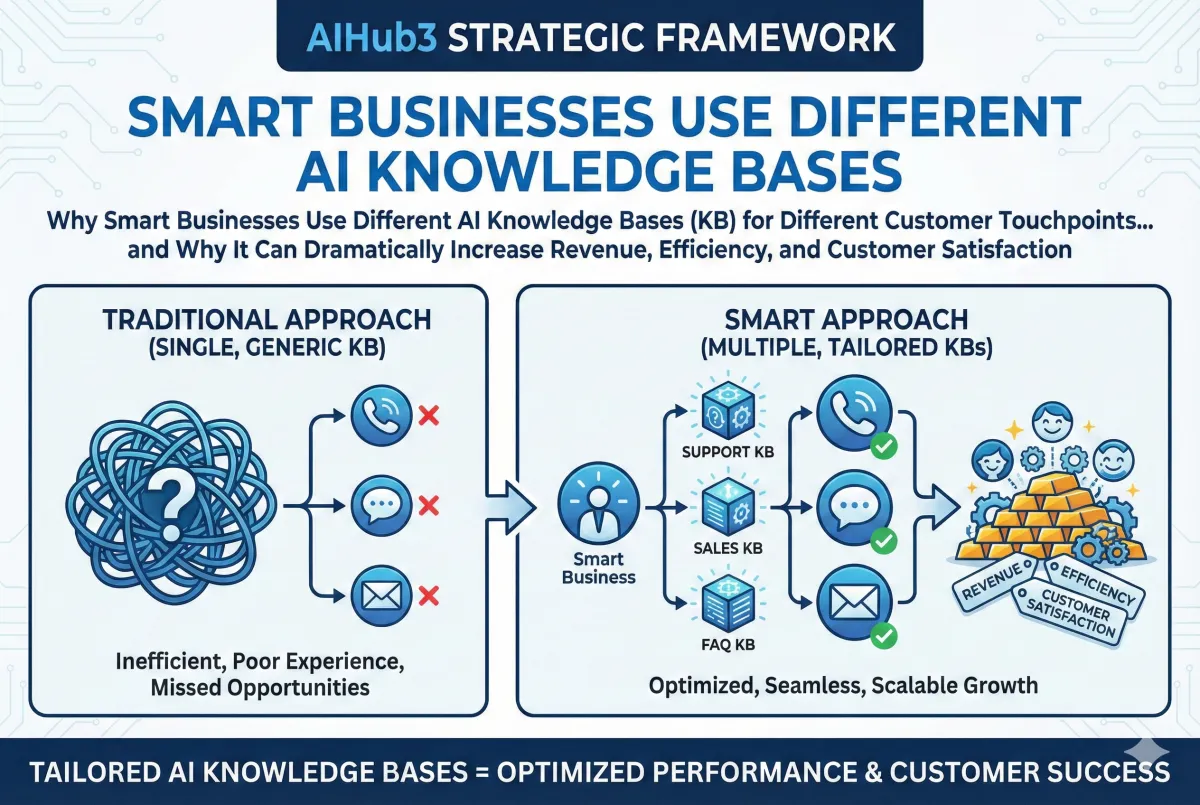
Smart Businesses Use Different AI Knowledge Bases
Why Smart Businesses Use Different AI Knowledge Bases (KB) for Different Customer Touchpoints
... and Why It Can Dramatically Increase Revenue, Efficiency, and Customer Satisfaction
When businesses start using AI phone agents, textback bots, or website chatbots, they often assume everything should run from one giant knowledge base. It sounds logical. It’s simpler. It feels “clean.”
But in practice, this creates the same problem as hiring one employee to handle: phone reception support tickets sales calls website demos lead qualification after-hours emergencies. No human can do all of that well. Neither can one AI using one massive, unfocused knowledge base.
High-performing companies now split their AI into multiple specialized agents, each powered by its own highly specific knowledge base. This single change instantly improves: customer experience lead conversion support quality compliance and operational efficiency.
Here’s why.
1. Every Customer Touchpoint Has a Different Intent
A phone caller isn’t the same as someone chatting on your website. A missed-call textback visitor isn’t behaving like someone browsing FAQs.
Voice callers want fast, conversational booking. Website chat users want detailed answers. Missed-call textbacks need urgency and persuasion. Support users need calm, accurate guidance.
One KB (Knowledge Base) cannot meet all intents. Separate KBs can.
Result: faster resolutions and fewer confused interactions.
2. Specialist KBs Reduce AI Errors and 'Hallucinations'
When a KB contains too much mixed information, the model becomes uncertain. Support information gets mixed with sales copy. Pricing gets mixed with troubleshooting. Policies collide with marketing language.
But a small, focused KB gives the AI razor-sharp clarity.
Voice Receptionist KB = short, simple, booking-focused. Website Chat KB = rich, structured, detailed info. Support KB = step-by-step troubleshooting.
Cleaner KBs = fewer mistakes.

3. Appointment Conversion Rises Sharply
Your AI receptionist should not teach visitors how your product works. Its only job is: answer briefly reassure redirect book the appointment. A dedicated receptionist KB keeps it laser-focused on conversion.
Businesses regularly see: 10–40% higher appointment booking rates 20–60% more missed-call conversions significantly higher show-up rates.
Why? Because the AI pushes toward booking, not toward long explanations.
4. Customer Service Costs Drop 30–70%
A support-oriented KB can resolve: common how-to issues policy questions order status refund explanations technical troubleshooting onboarding steps without involving a human.
A sales KB would fail at this. A support KB excels.
With the right KB architecture, AI can deflect the majority of simple tickets. Humans handle only complex issues. This saves thousands per month.

5. Channel-Specific Tone Leads to Higher Satisfaction
Your AI must sound different on each platform.
Voice AI needs warmth and empathy. Chatbot needs clarity, speed, and structured text. Social media AI needs informal and friendly phrasing. Missed-call textback AI needs confidence, urgency, and brevity.
Tone is part of the knowledge base. Channel-specific KBs allow the AI to speak the right “language.”
6. Compliance Becomes Safer and Easier
Support KBs contain precise rules. Voice KBs can include recording disclaimers. Chat KBs can include GDPR-safe handling of personal data.
One KB mixing them all increases risk.
Separate KBs reduce legal exposure and make audits easier.
7. Faster Iteration Means Faster Growth
Updating one giant KB is slow and risky.
Updating several small KBs is fast, safe, and measurable.
You instantly know which update affected: the phone receptionist the website chatbot the support bot the textback agent the missed-call conversion bot. Iterating faster means outpacing competitors.
8. You Can Measure Each KB’s Business Impact Clearly
If everything uses one KB, you don’t know what works.
Separate KBs let you track channel KPIs:
Voice AI KPIs Appointment Booking Rate Call Deflection Rate Missed-Call Conversion Rate AI-to-Human Escalation %
Website Chat KPIs Engagement Rate Lead Capture Rate Question Match Accuracy Drop-Off Rate
Support AI KPIs First Contact Resolution Cost per Ticket CSAT Escalation %
Marketing / Textback AI KPIs Response Rate Show-Up Rate Lead Revival %
This lets you optimize each channel individually.
9. Deep Personalization Becomes Possible
You can tailor KBs to: different services languages audiences regions product lines seasons campaigns industries.
Imagine: Your property management AI has different KBs than your coaching AI. Your UK audience gets a different KB than your German audience.
This is impossible with one global KB. Effortless with separate KBs.
10. You Build a Multi-Agent AI Workforce — Not a Single AI Robot
One KB = one generic assistant. Multiple KBs = a professional AI team.
AI Receptionist AI Lead Recovery Specialist AI Customer Support Agent AI Website Sales Assistant AI After-Hours Agent AI Social Media Chatbot AI Billing Assistant
Each can be trained for a different purpose. Each can be measured, optimized, and improved.
High performers don’t create an AI assistant. They build an AI workforce.
And that’s where the competitive edge begins.
A 5-Step Plan to Implement Multi-KB AI in Your Business

Step 1 — Map your customer touchpoints
Phone calls Website chat Support tickets Missed calls Social media messages SMS/textback Email replies
Each touchpoint = one agent = one KB (Knowledge Base).
Step 2 — Choose one agent to improve first
Voice receptionist (best ROI) Support bot Website chatbot Lead revival bot
Start with one, then expand.
Step 3 — Build a very small, laser-focused KB
Include only: the answers this agent needs tone guidelines example dialogues rules fallback logic
Avoid long paragraphs.
Step 4 — Measure performance with 3 KPIs
Pick three per agent. Example for Voice AI: Booking Rate Drop-Off Rate Escalation Rate
Track weekly.
Step 5 — Iterate fast (7-day cycles)
Review transcripts Improve KB Add missing answers Tighten language Add guardrails Retest
Small KB → faster improvement.
Within a month, performance compounds.
Final Thought
AI is no longer “one assistant answering everything.” It is a coordinated team of specialists, each powered by a focused knowledge base and optimized for one job.

Businesses that embrace multi-KB, multi-agent systems will: convert more leads reduce more support workload achieve higher customer satisfaction operate with lower costs and outperform competitors still using one “general-purpose bot.”
If you want help planning your AI workforce, reach out — we design these systems at AIHub3.
#AIWorkforce #AIKNowledgeBase #AIHub3

